01 / 30

iO-CO · Movement Intelligence · 2026

Body · Mind · Balance

Movement is the brain’s first language. BMB measures how fluently body and brain still speak it — and how that changes over time.
Why this matters

The brain did not evolve to think.
It evolved to move.

Everything that defines us is a feat of movement — the dexterous hand, the upright stance, the speaking voice. Thought itself is built on the machinery of motion. As the neuroscientist Daniel Wolpert puts it, a creature that stops moving no longer needs a brain: the sea squirt roots to a rock for life, then digests its own.

The hand
Fine manual dexterity — tool use, craft, touch — runs on motor pathways most elaborated in humans.
The voice
Speech is the fine motor control of the vocal tract — the same class of machinery as balance.
The mind
Cognition is grounded in the sensorimotor system; the cerebellum predicts for thought as it does for movement.

Wolpert, The Real Reason for Brains (2011) · Koziol 2012 · Simonyan & Horwitz 2011

Why this matters

Balance is where body meets brain.

To stay upright, the brain fuses three senses — sight, balance and body-position — and reconciles them dozens of times a second. The vestibular system is our most connected sense, wired straight into the brain’s map-maker, the hippocampus. Balance is cognition you can see.

Vision
Where the world is, and how it moves around us.
Vestibular
The inner-ear sense of gravity, rotation and motion — the integrator.
Proprioception
The body’s own sense of where its parts are, from muscle and joint.

Brandt 2005 (Brain): bilateral vestibular loss → ~17% hippocampal atrophy & spatial-memory deficit · Peterka 2002

Why this matters

The signal is the change over time.

We are not putting in a probe and taking a reading. We are watching how well information flows — from the world, through the nervous system, and back out as movement — and how that flow shifts against a person’s own history. In brain health, the direction of travel is where the value lives.

~12%
per step faster
Each 0.1 m/s of gait speed tracks ~12% lower mortality across 34,485 adults — movement as a whole-system readout.
~6×
when both slip together
When movement and memory decline together, dementia risk multiplies. One reading can’t see that. A trajectory can.
Both
measures & trains
The same closed loop that reveals the state of the system also strengthens it — read and train, in one act.

Studenski 2011 (JAMA) · Tian 2020 (JAMA Netw Open) · Rogge 2017 (Sci Reports) · a functional readout, not a medical diagnosis

The gap

The layer no one measures.

How the world flows in through the senses, into the nervous system and brain, drives the body, and comes back out as movement — and how well that whole relationship works — is one of the most fundamental layers of human performance. We measure steps, sleep, heart rate and weight. No one measures this.

Not acquired
The data isn’t being captured — anywhere.
Not predicted
So no one sees the trajectory coming.
Not managed
Nothing acts on it, until something breaks.
Everyone, every age
Not a niche — a universal blind spot.

A fundamental gap — across data acquisition, prediction, intervention and diagnostics — and one of the root causes of the decline we see.

The platform

A movement intelligence platform.

Transforming how people strengthen body and mind — improving long-term health, confidence and longevity.
Measure
Movement quality, read as a neural signal.
Train
Brain–body adaptation through guided motion.
Predict
Functional trajectory, against a personal baseline.

Across a lifetime

Movement is the foundation of life.

Children
50%
Movement drives development
Better balance and coordination are associated with gains in learning and cognitive development of up to 50%.
Adults
84%
Balance predicts longevity
Inability to hold a 10-second one-legged stance carried an 84% higher mortality risk over the following decade.
Seniors
1 in 3
Decline shows up as a fall
One in three adults over 60 falls each year; half never fully recover their mobility.

Sherrington 2020 · Araujo 2022 (BJSM) · Rubenstein 2006

The most connected sense

The vestibular system.

It is far more than balance. It organises incoming information from the other senses and relays it to the brain — and it is one of the earliest, most overlooked systems to begin declining, from around the age of forty.

01
It calibrates every other senseThe reference frame that vision, hearing and body-position are measured against.
02
It connects movement, emotion and cognitionWired into the hippocampus, it supports spatial memory, navigation and executive function.
03
It is an early indicator of wider declineMeasurable dysfunction in ~35% of over-40s, rising to ~85% by 80 — yet almost no one measures it.

Hitier 2014 · Bigelow & Agrawal 2016 · Agrawal 2009

Balance: a connected system

One loop, continuously running.

Sense
Vision
sight
Vestibular
balance & motion
Proprioception
muscle & joint
Integrate
Central nervous system
cerebellum, cortex, brain-stem
Reweigh & predict
dozens of times a second
Act
Posture & eye control
motor output
Balance
the visible result

Strengthening the loop strengthens cardiovascular, biomechanical, sensory, motor and brain function together.  ·  Fuchs 2018

The problem

Modern life works against our foundations.

We evolved to move — to explore, adapt and survive. We no longer use our bodies and minds as they were built to be used.

1 in 3 over-40s show vestibular impairment
+41% increase in fall rates, 2012–2021
1bn people are classified as obese
10–27% of over-60s have sarcopenia
30% of adults live with musculoskeletal pain
1bn people affected by sleep apnea
+18% rise in neurological disorders since 1990
+15.6% increase in depression since 1990

Directional · WHO / NHS / GBD sources

The gap today

How we measure movement.

01
Mistake activity for ability
We track how much we move — not how well we move.
02
The hidden decline
Early signs show up in control, long before strength or endurance.
03
Body and mind, disconnected
Movement and cognition share neural pathways. As movement quality falls, attention and emotional regulation fall with it.

The shape of a life

Life in decline.

A B B C C D Evolutionary baseline Modern capacity Development Optimal Aging Birth Death Body & Mind function

Slower development · lower peak · earlier decline — modern capacity (blue·green·red) falls short of our evolutionary potential (green).

The cost of waiting

Decline arrives as a fall.

A fall is not the start of decline — it is where years of silent change finally land. The price is paid twice: in a life’s trajectory, and in the system’s bill.

The human cost
1 in 3  adults over 65 fall each year
18–33%  one-year mortality after a hip fracture
20%  enter long-term care after a hip fracture
The system cost
£21,120  average cost per serious fall
£2.3bn  annual UK cost — hip fractures alone
£6m/day  on a problem we don’t measure upstream

King’s Fund 2018 · Royal Osteoporosis Society 2024 · Sherrington 2020

Neuroplasticity

Decline is not destiny.

Balance, coordination and focus are not fixed traits — much of the functional loss is modifiable. Inactivity accelerates it; the right stimulus helps the brain retrain the loop.

Motor control
Stronger, faster, more accurate movement.
Cognitive function
Sharper focus and faster processing.
Sensory integration
Better calibration across the senses.
Resilience
Reduced injury risk and a longer healthspan.

Rogge 2017 (Sci Reports): 12 weeks of balance training improved memory & spatial cognition · Battilana 2020

The evidence

The science is established.

Fewer falls
−24%
Fall-rate reduction
Balance & functional exercise challenging gait, stability and movement control.
Longer life
−12%
Lower mortality
Per 0.1 m/s of gait speed — movement quality as a whole-system marker.
Sharper mind
1 yr
Attention gains held
Motion-capture training combining cognitive and physical challenge.

The science works. What has been missing is a platform to deliver it.

Sherrington 2019 · Studenski 2011 (JAMA) · Anguera 2022 (UCSF Neuroscape)

Our objective

Redefining the function curve.

A B B C D Evolutionary potential Development Optimal Aging Birth Death Body & Mind function

We develop toward a peak (B), hold it briefly, then decline to death (D). BMB works on the shape of that curve.

Lever · extend the optimal phase

Extending optimal.

A B C Optimal, held far longer Development Optimal — extended Aging Birth Death Body & Mind function

Lever one — hold peak function for longer: push the onset of decline to the right (C moves out).

Lever · soften the aging slope

Reducing decline.

A B C D A long healthy life compresseddecline Development Optimal — extended Aging Birth Death Body & Mind function

Lever two — compress the decline: a long life at full function, then a short, late fall-off (the aging phase shrinks).

The solution

From movement, to action.

01
Understand movement
Capture and interpret the signals that reveal how well people move — not just what they do.
02
Brain–body training
Multi-sensory experiences that challenge focus, coordination and reaction together.
03
Unify human data
Movement, cognition, sleep and recovery — connected into a living map of human capability.
04
Turn insight into action
Translate complex measures into simple, personalised guidance that drives behaviour change.

The product

Stand, respond, adapt.

The board reads how you move and answers in real time — assisting or challenging, moment to moment.

One platform, every stage of life

Where BMB works.

Clinical & rehab
Assessment and recovery in physio and rehabilitation settings.
Performance
Sharper reaction, coordination and control for elite and everyday athletes.
Development
Balance and coordination as a foundation for learning in the young.
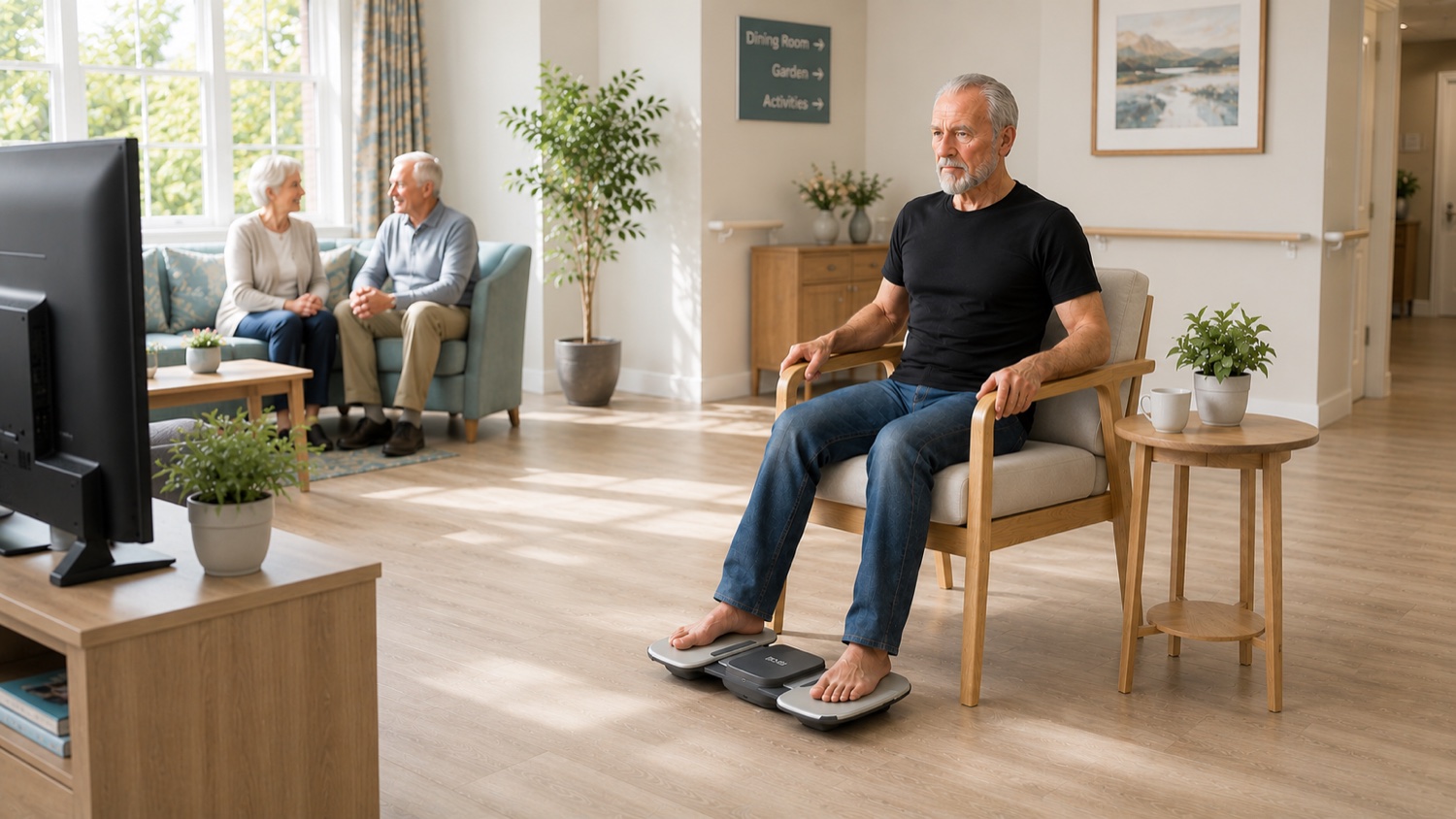
Elderly care
Early detection and fall prevention, keeping people independent for longer.

The hardware

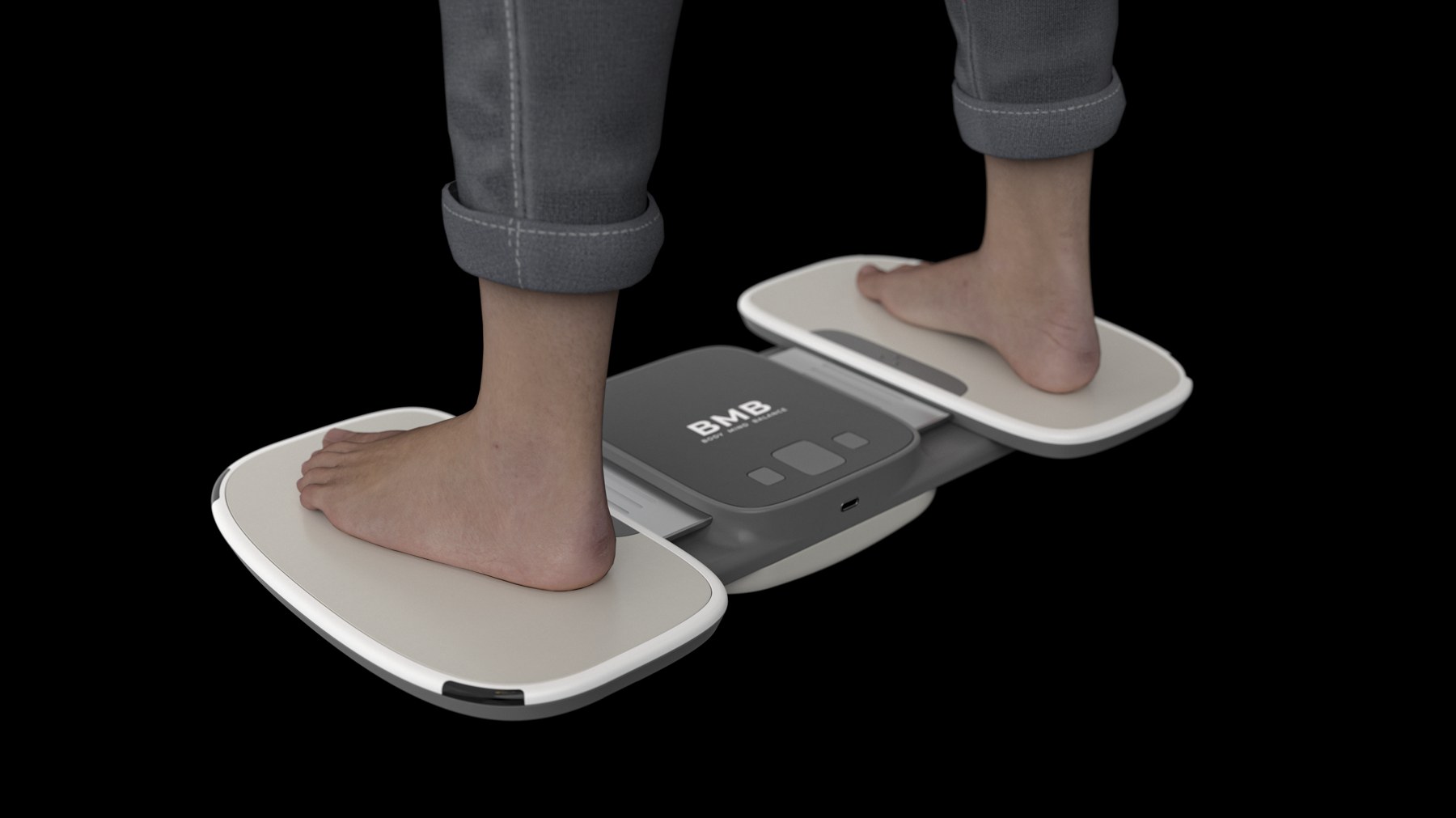
A board that responds.

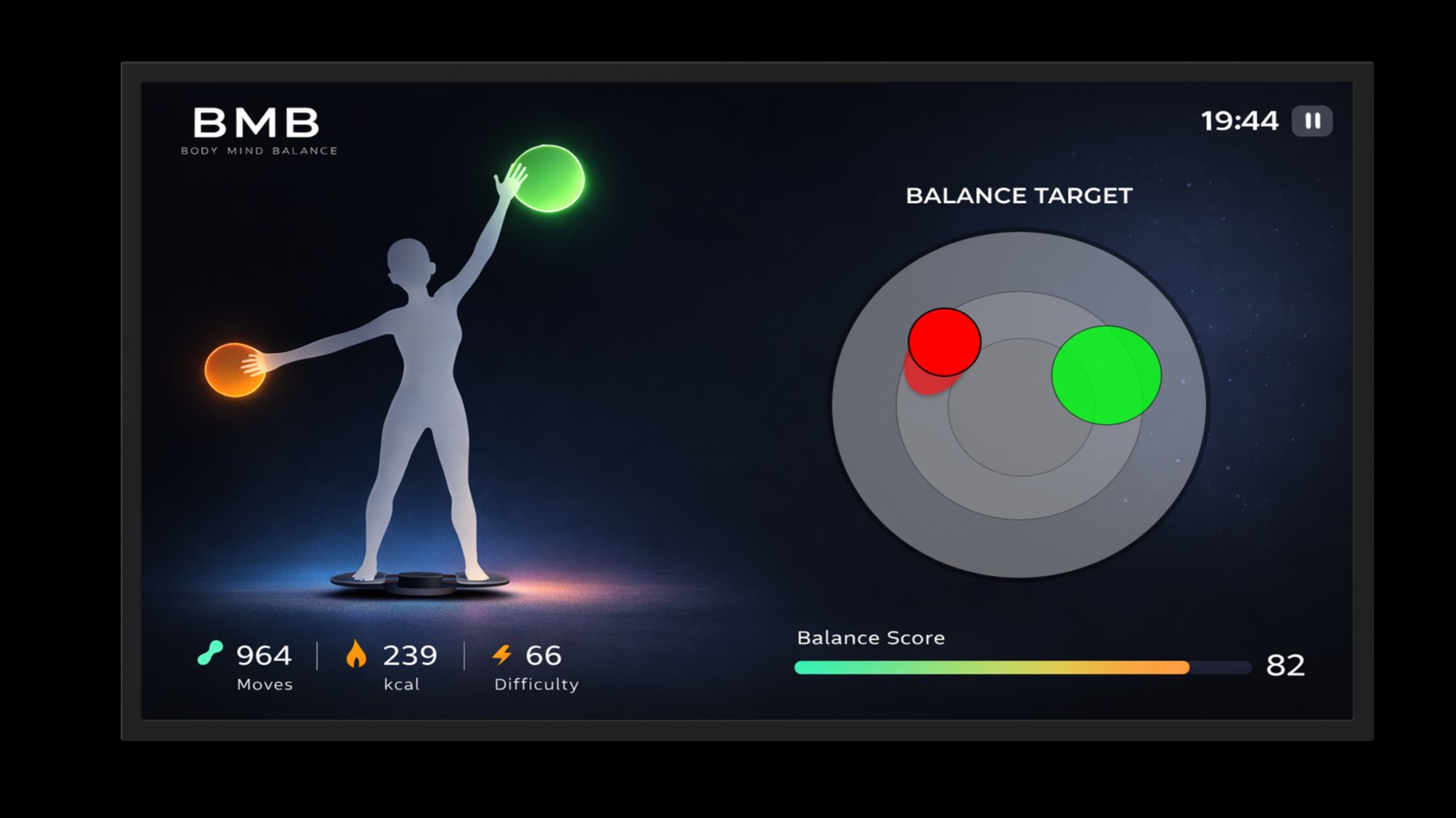
Sensors read force, position and motion in real time; the surface shifts from stable to challenging in a precise, controlled way; a screen closes the loop.
Board
Real-time controlled instability — assist or challenge, tuned to the person.
Tracking
3D motion capture, interpreted frame by frame.
Feedback
Audio-visual response that closes the loop.

The data layer

Movement intelligence.

Every session adds to a unified picture — a functional record that grows more valuable the longer it runs.

Model
Movement, cognition and recovery, in one evolving profile.
Age
Functional age and resilience, against a personal baseline.
Twin
A living model that sharpens prediction and personalises each session.

A functional, comparative record — not a medical diagnosis.
The system

A continuous loop.

The idea

BMB mirrors the nervous system.

The person
External stimuli
the world, the screen
Central nervous system
sense → process → act
Biomechanics
the body responds
The platform
Sensorium
force, position, motion
BMB AI models
read → interpret → respond
Board sensors
the surface adapts

A machine built in the shape of the system it measures.

Why it works

One board, many modalities.

BMB combines what usually takes several disciplines — strength, flexibility, coordination, focus, cognitive load and sensory integration — into one connected workout.

One session in the place of Yoga, Tai Chi, Pilates, balance work and brain-training — challenging the whole system at once.

Why it gets used

Built for adherence.

Universal access
Non-invasive · low cost · safe · low effort — usable across ages and abilities.
Rapid engagement
Natural · fast · measurable — feedback you can see, in minutes, not months.
System-level advantage
Universal · scalable — one platform that works everywhere, and improves with use.

A new standard

Five innovations, one platform.

A neuroscience-based standard for human performance — and the basis for patent filings during the funded period.

01
Movement as a neural signal
Decodes control and coordination in real time.
02
Mirrors the biological system
The body’s architecture, in hardware and models.
03
Predictive intelligence
Capability and trajectory against a baseline.
04
Adaptive feedback loop
Keeps the user in the optimal learning zone.
05
Efficient & effective
Compounding benefit across body and brain, in minimal time.

Status · honest

Where we are.

Hardware
Early balance-board prototypes built. Industrial-design vision developed and initial sensors integrated.
Software
User-facing software in development, to validate prototype performance and capture early test data.
Data
Data sources scoped (board, IMU, mocap). Capture pipeline and secure storage in design.

Technology Readiness Level 4 — core technology demonstrated; next step is a deployable product for the target market.

The pilot

Proving it in the real world.

A structured pilot — mocap ring, floor-level cameras, visual feedback and a pilot clinician — designed to generate the first comparative dataset.

60
Participants
Across the target age brackets.
12
Sessions each
Enough to see a trajectory, not just a snapshot.
720
Movement assessments
The seed of the longitudinal dataset.

Measure what makes us human.
Then help it last.

Movement is the brain’s first language. BMB makes it measurable, trainable, and trackable — for life.

Private & confidential← → to navigate
Rotate to landscape